
I bought RoC Retinol Correxion Night Cream for the first time on a Tuesday in January. I had a jar of it sitting on my bathroom shelf by Thursday. By the following Saturday, I was convinced I had made a terrible mistake. My forehead was flaky, there was a new breakout near my left jawline that had nothing to do with my period, and the fine line above my upper lip looked, if anything, slightly more pronounced than it had before I started. I almost returned it.
What I did not know at the time was that everything happening to my skin was completely normal. The flaking, the breakout, the apparent backward progress: all of it is a predictable part of how retinol works. Nobody told me that. The packaging certainly did not. This review is the one I wish I had found in week two, before I almost quit.
The Quick Verdict
A genuinely effective retinol cream that earns its reputation, but only if you understand the adjustment phase. The first four weeks are not the test of whether it works. Weeks nine through twelve are.
Amazon Check Today's Price →If you're going to try retinol, start with a formula that gives your skin a buffer built in
RoC Retinol Correxion is one of the few drugstore retinol creams with a mineral complex that cushions the adjustment phase. It is not painless, but it is more forgiving than a pure retinol serum for someone just starting out.
Amazon Check Today's Price on Amazon →How I Used It (And What I Was Testing For)
I am not a dermatologist. I am someone who spent seven years as a retail skincare buyer for a regional department store chain, which means I have read more product development briefs and ingredient decks than most people ever will. When I left that job and started reviewing independently, I made a rule: I test everything for at least twelve weeks before writing about it. Eight weeks is not long enough for retinol. Anyone who tells you otherwise is either selling something or only showing you the good part.
My skin is combination, slightly sensitive along the cheeks and nose, with a history of mild hormonal breakouts. I applied RoC Retinol Correxion three nights per week for the first month, then moved to five nights a week for months two and three. I used a plain ceramide moisturizer on top and SPF 50 every morning without exception. No acids layered at night while the retinol was active.
What I wanted to know was specific: does the RoC mineral complex actually buffer the irritation enough to make this usable for someone with sensitive skin, does the purge phase hit as hard as it does with higher-percentage formulas, and is the visible improvement at twelve weeks worth the awkward middle stretch. The answers, in order, are yes, mostly, and yes.
Weeks One and Two: The Skin Is Adjusting, Not Failing
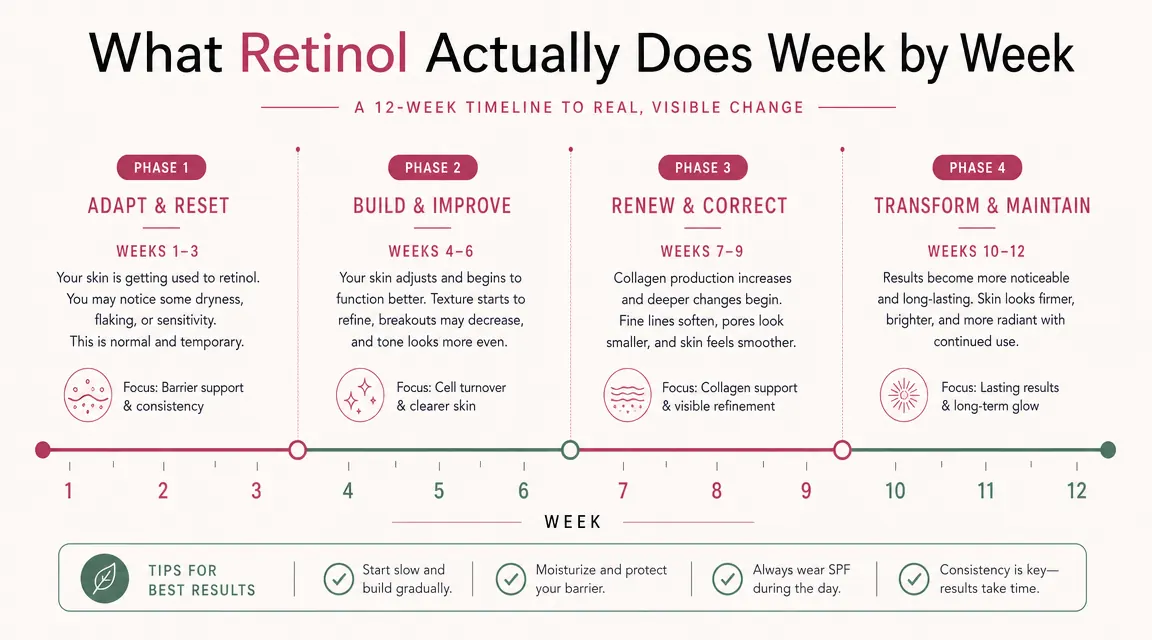
Retinol accelerates cellular turnover. That sounds like a good thing, and eventually it is. In the first two weeks, what it actually means is that your skin is trying to shed old cells faster than it is used to, and the surface can become rough, patchy, and occasionally flaky in spots that were fine before. This is not a reaction. It is not a sign of sensitivity. It is the process working.
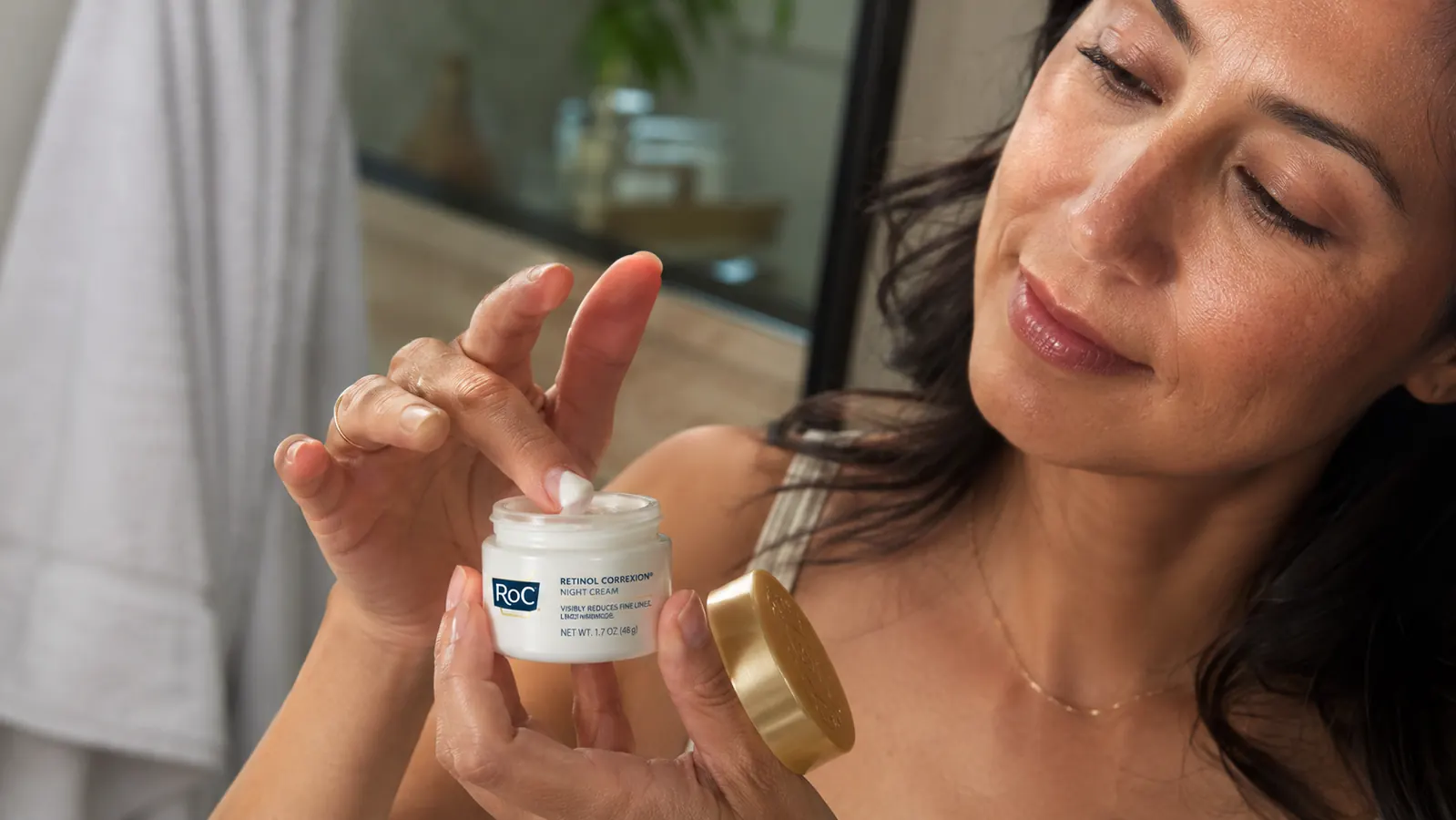
With RoC specifically, the flaking was less pronounced than I have seen with water-based retinol serums. The mineral complex in the formula, which includes copper, zinc, and magnesium, appears to slow down the surface disruption without blocking the retinol from doing its job at a deeper level. The texture of the cream itself is thicker than a serum and provides a physical barrier that helps. I used a pea-sized amount applied to dry skin, waited ten minutes, then applied my moisturizer over the top. That buffering method matters more in the first two weeks than the product choice.
Mild dryness near the corners of my mouth and some tightness along the jaw by day ten. No redness. No significant irritation. For a first-timer who has never used any retinoid before, this phase will likely feel more intense than it did for me. I had built some baseline tolerance from a retinol-containing eye cream I had been using for about a year.
Weeks Three and Four: The Purge Phase, Explained Plainly
The purge is real, and most reviews either gloss over it or attribute it to the product being wrong for their skin. It is almost never wrong skin. Retinol pushes congestion to the surface faster than it would clear on its own. If you have any underlying clogged pores, and most of us do after the age of thirty, retinol will make them visible as small blemishes before they clear. This typically peaks around weeks three and four.
My jawline breakout in week two was the beginning of this. By week three I had two additional small blemishes near my left cheekbone, which is not a place I normally break out. They were not cystic, not painful, and each resolved within about five days. The purge on RoC felt shorter and less intense than what I experienced years ago when a derm gave me a prescription retinoid. The lower concentration and the cream base appear to draw the process out over a longer period, but with less dramatic individual breakouts.
The first four weeks of retinol are not the test of whether it works. Weeks nine through twelve are. Anyone who quit before then, including me the first time I tried a retinoid, quit before they saw anything.
If you have been using RoC Retinol Correxion for three weeks and your skin looks worse: this is probably why. It is not a signal to stop. It is a signal to keep your routine simple, skip any acids or exfoliants, stay hydrated, and give it another four weeks before making a judgment call.
Weeks Five Through Eight: The Stabilization Window
By week five, the flaking had stopped entirely. The small breakouts were gone. My skin felt more even-textured, though not dramatically so. This is the stabilization window, and it is often the phase people mistake for the final result. They look in the mirror at week six, see skin that is mostly back to its baseline but slightly smoother, and conclude the product is fine but not life-changing. That is not the result. The result is still four to six weeks away.
The RoC formula has a texture that works in this phase specifically. It absorbs without leaving a film, does not pill under moisturizer, and the scent, which is mild and slightly medicinal, fades within a few minutes. I moved from three nights per week to five during week five with no additional irritation. That transition felt smooth in a way it would not have if I had tried it during the purge phase.
My skin looked calm. Texture across the cheeks was starting to even out. The fine line above my upper lip that had briefly looked worse in week one was returning to its prior state. No dramatic improvement yet, but no backsliding either. Stabilization is underrated as a milestone.
Weeks Nine Through Twelve: What the Product Is Actually Doing
Week nine is when I stopped second-guessing and started noticing. The texture across my forehead, which had always had some low-level roughness from years of mild sun exposure, was genuinely smoother. Not smooth like a filter, but smooth in the way that a well-maintained surface looks different from one that has been neglected. The pores along my nose looked smaller, though a dermatologist would probably tell you that retinol does not change pore size so much as it clears the debris that makes them look enlarged.
The fine line above my lip, the one I had been watching since week one, was visibly less defined. I cannot give you a percentage improvement because I did not measure it with calipers. What I can tell you is that a friend who sees me regularly asked at week eleven if I had changed something about my skincare routine. She specifically mentioned that my skin looked more even. I had not mentioned I was testing anything.
The line across my forehead, which is deeper and was a lower priority target, was essentially unchanged at twelve weeks. Deeper wrinkles take longer than three months and may require a higher concentration or a prescription retinoid to show significant movement. RoC Retinol Correxion is a 0.1% retinol formula, which is a reasonable starting concentration but not a clinical dose. Expectation calibration matters here.

What the Packaging Gets Wrong (And What It Gets Right)
The outer box of RoC Retinol Correxion shows imagery suggesting visible wrinkle reduction. It does not specify a timeline. Most marketing materials imply results by week four or week eight. In my experience, week eight is about the time your skin finishes adjusting and stabilizing, not the time visible results appear. That distinction is not a minor one for someone who is on the fence about whether to keep going.
What the packaging does get right: the formula is straightforward. The ingredient list is not padded with fillers. Retinol is the active, the mineral complex is a genuine addition rather than a marketing tag, and petrolatum and glycerin provide the emollient base without relying on heavy fragrances or unnecessary botanical extracts that can irritate sensitized skin. There is no sunscreen in the formula, which means it belongs in a nighttime routine and requires separate SPF in the morning. That is not a flaw, it is the correct design.
What I Liked
- Mineral complex (copper, zinc, magnesium) buffers early irritation better than plain retinol serums at the same concentration
- Cream base is useful for combination and dry skin types who find retinol serums too drying
- No fragrance compounds that would worsen irritation during the adjustment phase
- Straightforward formula without unnecessary botanical extracts that can interact with retinol
- Widely available and competitively priced for a consistent, well-tested retinol product
- Genuine visible texture improvement at weeks nine through twelve for fine lines and surface evenness
Where It Falls Short
- 0.1% retinol concentration is appropriate for beginners but may not produce meaningful results on deep or established wrinkles
- The purge phase in weeks three and four is real and the packaging does not prepare you for it
- Jar packaging exposes the retinol to air and light with every use, which can accelerate oxidation
- Results require a twelve-week minimum commitment before you can assess them fairly
- Not suitable for layering with AHAs, BHAs, or vitamin C in the same routine without careful scheduling
The Jar Packaging Issue (A Real Concern)
Retinol degrades when exposed to air and light. Every time you open a jar and dip your finger into it, you expose the contents to both. A tube or pump dispenses retinol while keeping the rest of the formula sealed. The jar format that RoC uses for this cream is a legitimate criticism, and it is one that does not get enough attention in standard reviews. By the time you reach the bottom third of the jar, you may be working with a less potent product than you started with, particularly if the jar sits near a window or gets warm.
A practical workaround: use a small spatula instead of your finger to dispense the product, store the jar in a drawer away from light and heat, and use it within four to five months of opening. Retinol products that have turned yellow or developed an unusual smell have likely degraded and should be replaced.
Who This Is For
RoC Retinol Correxion is a good first retinol for someone with combination or dry skin who wants to address early fine lines, uneven texture, and mild skin dullness. The cream base and mineral complex make the adjustment phase more manageable than a straight retinol serum. If you have never used a retinoid before and want to start without getting a prescription, this is one of the more sensible over-the-counter options at this price point. You need to commit to at least twelve weeks and you need to accept that weeks three and four will probably not look like progress.
Who Should Skip It
If you are dealing with active, inflamed acne across a significant portion of your face, retinol is not the right first step. It will not worsen acne in the long term, but the purge phase can compound existing inflammation and make the situation harder to read. Get the acne controlled first, then introduce retinol. If you have rosacea or a compromised skin barrier, check with a dermatologist before starting any retinoid. And if you have already tried a prescription retinoid and found 0.1% over-the-counter retinol underwhelming, this formula will likely land in the same category for you. You would be better served looking at a prescription-strength option. For information on starting a retinol routine without triggering irritation, I have a step-by-step guide at the link below.
If what you are looking for is a twelve-week commitment to a well-formulated retinol cream that will deliver visible improvement in fine lines and surface texture, RoC Retinol Correxion earns a straightforward recommendation. The results are real. The timeline is just longer than the box implies. My full three-month write-up with week-by-week tracking notes is in the companion review linked below if you want more detail on the long-term picture.
Ready to commit to twelve weeks? Start with a formula that builds in a buffer for your skin
RoC Retinol Correxion Night Cream is one of the most tested drugstore retinol formulas available. It is not the flashiest option, but it delivers for people who stick with it past the purge phase.
Amazon Check Today's Price on Amazon →