
I spent two years buying retinol products and leaving them half-finished in a drawer. Not because they didn't work, but because I started them wrong every single time. Jumped in nightly from day one, skipped moisturizer over the top, and then spent two weeks with a flaky, red forehead wondering if retinol was just not for me. It is for me. I was just doing it at the wrong speed.
Retinol irritation is real, but it is almost always a pacing problem. The ingredient itself is well-studied and genuinely effective for smoothing texture, fading uneven tone, and reducing the appearance of fine lines over time. The people who stick with it are not tougher than the rest of us. They just started slower. This guide walks through exactly how to do that, using the RoC Retinol Correxion Night Cream as the recommended starting point because its formula is designed for building tolerance gradually.
Starting retinol and want a formula built for beginners? RoC Retinol Correxion Night Cream is consistently one of the easiest first retinols to tolerate.
It has 4.4 stars across nearly 24,000 Amazon reviews, and the cream base does a lot of the buffering work for you. Worth seeing the current price before you start building your routine.
Amazon Check Today's Price on Amazon →Why Retinol Irritates Skin in the First Place
Retinol speeds up how quickly your skin cells turn over. That sounds like a good thing, and it is, once your skin adapts. But in the early weeks, that accelerated turnover can outpace your barrier's ability to keep up. The result is that tight, flaky, stinging sensation that sends most beginners reaching for a cold compress and swearing off the ingredient forever.
Dryness makes the irritation worse. If you apply retinol to skin that is already slightly dehydrated, which most of us are in the evening after a full day, the ingredient has less cushion to work with. And applying it to freshly washed, still-damp skin where the barrier is temporarily more permeable makes the penetration more aggressive than it needs to be. Both mistakes are easy to avoid once you know about them.
The concentration matters too. A serum with 0.5% or 1% retinol applied nightly to unprepared skin will wreck your barrier faster than a cream with a lower starting concentration used every third night. This is why starting with a well-formulated cream rather than a high-percentage serum makes sense for most beginners. The cream base slows delivery. That slower delivery gives your skin time to catch up.
Step 1: Choose the Right Formula for Where You Are Starting
Not all retinol products are equal for beginners. High-percentage serums are built for skin that has already been using retinol for six months or more. If you are starting from scratch, look for a cream-based formula with a lower concentration, ideally in the 0.1% to 0.3% range, paired with moisturizing ingredients that help offset the drying effect.
The RoC Retinol Correxion Night Cream fits this profile well. It uses a purified retinol in a cream base with minerals including magnesium, copper, and zinc, which support the skin's structural proteins. It is not a stripped-down serum that hits your skin all at once. The texture is rich enough that it does some of the buffering work passively, which reduces how much extra moisturizer you need to apply on top during the adjustment phase.
If you have very sensitive skin or a known history of reacting to actives, look for a product labeled 'gentle' or 'sensitive skin formula' within any retinol line. Starting at the mildest option in a range and building up over months is a much better plan than starting in the middle and hoping for the best.
Step 2: Wait for Skin That Is Dry, Not Damp
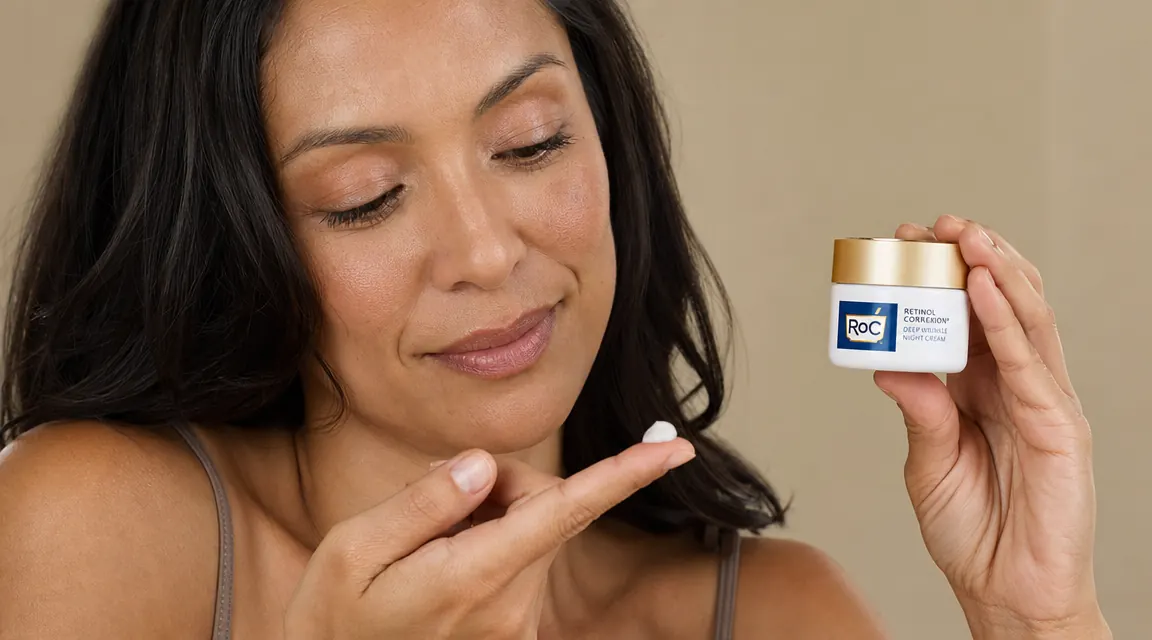
Timing your application correctly makes a meaningful difference. After you cleanse at night, wait 20 to 30 minutes before applying retinol. Your skin should feel fully dry, not just towel-dried. That waiting period lets the barrier close back up slightly, which reduces how deeply and aggressively the retinol penetrates in that first pass.
Some people find that this single change, going from applying retinol on slightly damp skin to waiting for fully dry skin, cuts their irritation by half. It sounds like a small thing, but skin permeability changes significantly in the minutes after washing. That temporary permeability is a feature for things like hyaluronic acid, which you want absorbed quickly. For retinol, it works against you.
Keep your cleanser gentle on retinol nights. Avoid exfoliating washes or cleansers with salicylic acid on the same night you use retinol. Running two actives in the same session gives your skin two things to react to instead of one, and you will have no way of knowing which one caused the irritation if something flares up.
Step 3: Use a Pea-Sized Amount. Genuinely Pea-Sized.
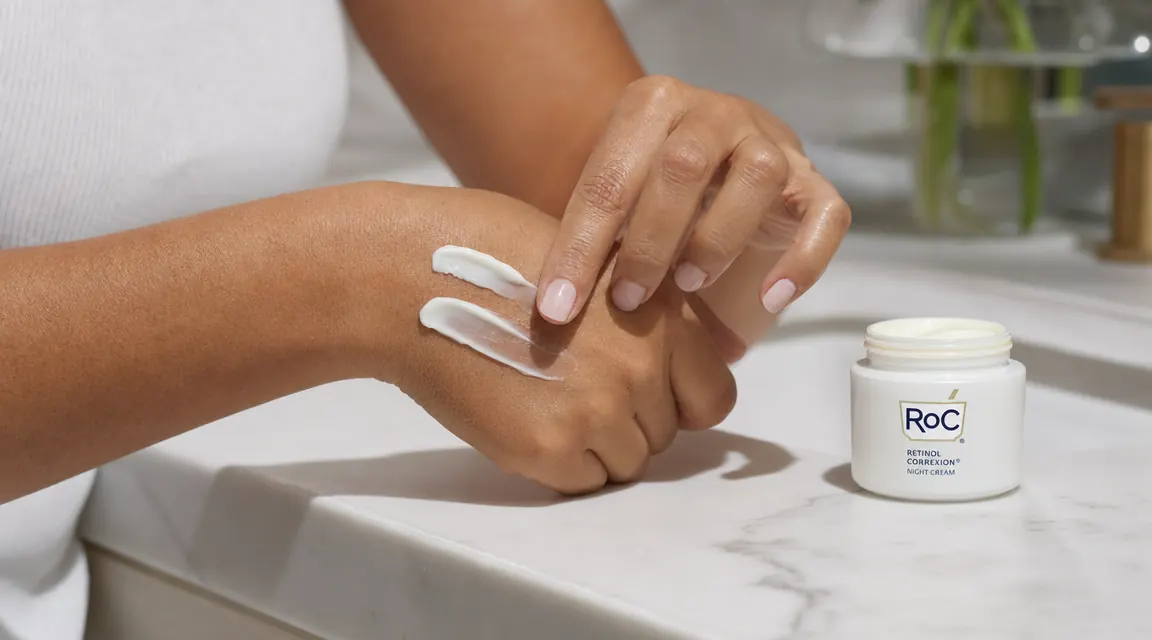
One of the most common beginner mistakes is applying too much product. More retinol does not mean faster results. It means more irritation with no additional benefit above a certain threshold. A pea-sized amount, roughly the size of a lentil for the face, covers your entire face and neck with enough product to be effective. Anything more and you are just stacking irritation potential without gaining anything.
Dot the cream across your forehead, both cheeks, your nose, and your chin. Then blend outward with light pressure. Avoid the eye area entirely for the first two months. The skin there is thinner and more reactive, and the margins for error are smaller. Once your skin has adjusted to retinol on the rest of your face, you can decide whether to cautiously extend toward the orbital bone using a separate, dedicated eye-area retinol if you want to address that area specifically.
A pea-sized amount covers your full face effectively. More product does not mean faster results. It means more irritation and no additional benefit.
Step 4: Buffer With a Moisturizer on Each Side
Buffering means applying a plain moisturizer before your retinol, then again after. This is sometimes called the sandwich method. The moisturizer you apply before creates a thin layer between the retinol and your skin, slowing how quickly it penetrates. The moisturizer applied after helps counteract the drying effect and gives your barrier something to work with overnight.
For the before layer, use a simple, unfragranced moisturizer without active ingredients. Something like a plain ceramide cream or a basic peptide moisturizer works well. Apply a thin layer, wait two to three minutes for it to absorb without being fully dry, then apply your retinol on top. Once the retinol is blended in, apply another layer of the same moisturizer over the top.
As your skin builds tolerance over the first six to eight weeks, you can gradually reduce the buffering. Many people move from a full sandwich to just a moisturizer after the retinol. Some get to a point where they apply retinol directly to dry skin with no pre-moisturizer at all. The goal is to work your way there slowly, not to skip ahead because you are feeling good after two weeks.

Step 5: Follow a Frequency Ramp-Up Schedule and Hold to It
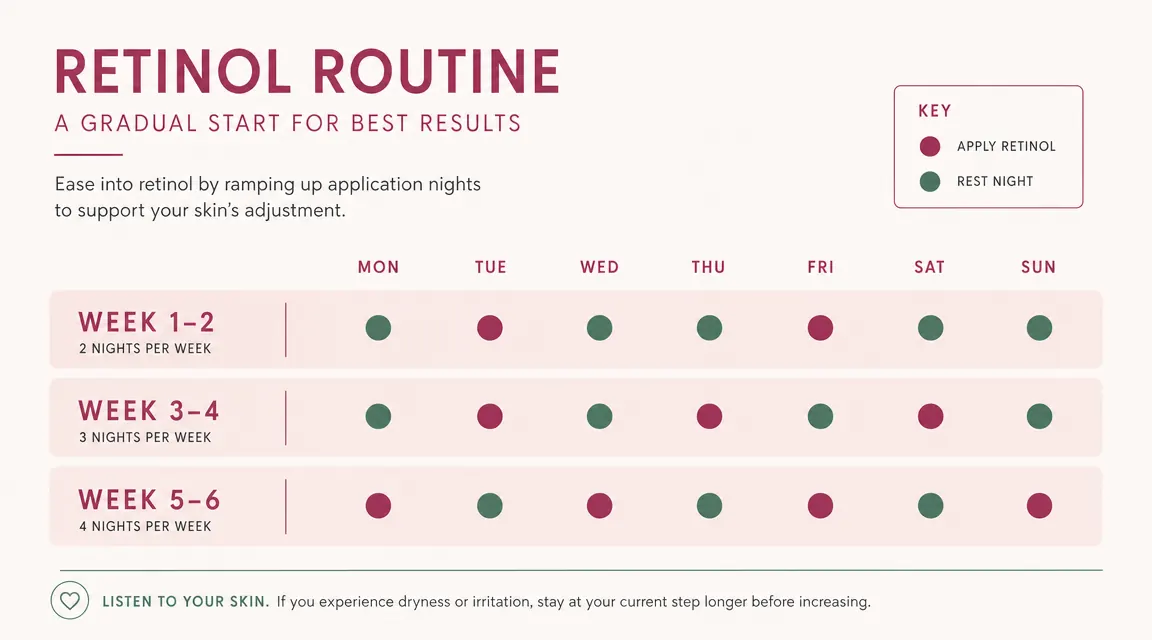
The most important variable in a successful retinol introduction is frequency. Starting at once per week feels almost insultingly slow if you are eager to see results. Do it anyway. Weeks one and two should be once per week only. Weeks three and four can move to twice per week, with at least two nights in between each application. By weeks five and six, most skin types are ready for every other night. After eight to ten weeks of consistent every-other-night use with no significant irritation, you can evaluate whether a nightly application makes sense for your skin.
If you do experience redness, tight skin, or noticeable peeling at any stage in that progression, pull back one level on frequency rather than stopping entirely. Stopping and restarting resets your skin's adaptation each time. It is better to back off to once a week for a couple of weeks and then rebuild than to quit and start from scratch in three months.
Consistency matters more than speed here. A person using retinol correctly twice a week for six months will almost certainly see better results than someone who pushed to nightly in week three, irritated their skin badly, quit for two months, and restarted. The ingredient rewards patience in a way that most skincare actives do not.
What Else Helps During the Adjustment Phase
Sunscreen becomes non-negotiable once you start retinol. Retinol increases your skin's sensitivity to UV exposure, and sun damage will undo the cellular turnover benefits faster than the retinol can deliver them. A broad-spectrum SPF 30 or higher every morning, including overcast days, is the maintenance work that makes retinol actually pay off over time.
Skip any other actives on retinol nights during the first two months. That means no vitamin C serum, no AHA or BHA exfoliant, no benzoyl peroxide. You can absolutely use all of those in your routine, just on alternating nights. A simple approach: use retinol Monday, Wednesday, and Friday nights. Use your other actives Tuesday, Thursday, and Saturday. Give your skin Sunday as a rest night with just cleanser and moisturizer.
If you experience what feels like a skin purge in weeks two through four, which can look like a temporary increase in small breakouts or congestion, this is a documented and normal phase. The accelerated cell turnover that retinol drives can push out congestion that was already forming under the surface. It typically resolves on its own within four to six weeks if you hold your frequency steady and do not over-treat the breakouts with additional actives.
For deeper reading on what the RoC Retinol Correxion formula specifically delivers across a three-month timeline, the full review covers week-by-week results and tolerability from someone who tracked the adjustment phase in detail. And if you want to understand why retinol is worth the patience at all, the case for retinol night cream covers the ingredient's clinical track record in plain terms.
A Note on When to Stop and Check In With a Dermatologist
Mild flaking and slight tightness in the first two weeks are normal and expected. Persistent burning that lasts more than a few minutes after application, open irritation, or skin that becomes noticeably inflamed and stays that way for more than a few days is worth pausing and checking with a dermatologist before continuing. Some skin conditions, including certain forms of rosacea and eczema, are contraindicated for retinol, and a professional look at your specific skin history is always worth more than any guide.
Most people, including those who describe themselves as sensitive, can use retinol successfully if they pace correctly. The slow introduction approach described in this guide is the same one most dermatologists recommend for first-time retinol users. The difference between giving up and succeeding with this ingredient is almost always just how you start.
Ready to start? The RoC Retinol Correxion Night Cream is a consistently recommended first retinol with a formula that does some of the buffering work for you.
Nearly 24,000 reviews on Amazon. A cream texture that blends easily and plays well with a moisturizer on each side. Check the current price and see if it fits your routine.
Amazon Check Today's Price on Amazon →